



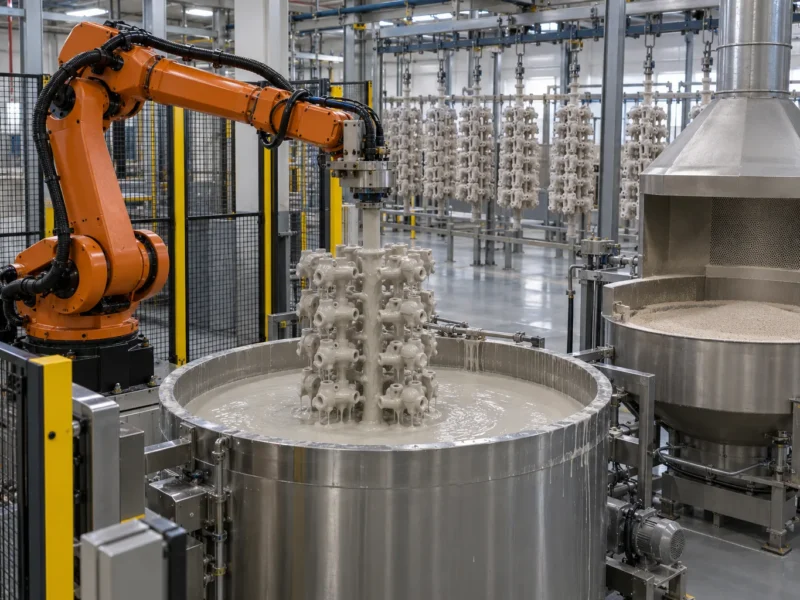
Most investment castings made in China use one of two shell systems: silica sol (colloidal silica) or water glass (sodium silicate). Both follow the lost-wax route, but the shell binder changes the surface, the accuracy and the cost of the casting.
Comparison
| Silica sol | Water glass | |
|---|---|---|
| Shell binder | Colloidal silica | Sodium silicate |
| Typical surface (as-cast) | Ra 3.2–6.3 µm | Ra 6.3–12.5 µm |
| Typical tolerance | ISO 8062-3 DCTG 4–6 | ISO 8062-3 DCTG 7–9 |
| Fine detail, thin walls | Very good | Fair |
| Typical alloys | Stainless, alloy and tool steels | Carbon and low-alloy steels |
| Face coat | Zircon flour and zircon sand | Quartz or zircon flour and sand |
| Back-up coats | Fused silica or mullite | Quartz, chamotte or mullite |
| Coats and drying | Typically 5–7 coats, hours of controlled drying per coat | Typically 4–6 coats, chemically hardened (NH4Cl or AlCl3) |
| Shell build time | About 2–3 days | About 1 day |
| Pattern wax and dewax | Medium-temperature wax, steam autoclave | Low-temperature wax, hot water at about 90–95 °C |
| Shell firing | About 1,000–1,100 °C | About 850–950 °C |
| Cost | Higher | Lower |
| Typical parts | Pump and valve parts, food and medical parts, marine hardware | Machinery, agricultural, construction and hardware parts |
Typical values; actual results depend on the part, the alloy and the foundry.
How to choose
- Choose silica sol for stainless steel, visible or functional as-cast surfaces, fine detail and tighter tolerances.
- Choose water glass for carbon and low-alloy steel parts that are machined on their functional faces, and for larger or heavier parts where the piece price matters more than the as-cast finish.
- If either route could work, ask for both prices. We quote both routes in that case and recommend the one that fits the part.
- Some foundries build a composite shell: silica sol face coats with water glass back-up coats. It improves the surface over plain water glass at lower cost than a full silica sol shell.
Tolerances are explained in more detail in investment casting tolerances.
Frequently asked questions
Which process is more common for export castings?
Silica sol is common for stainless steel and precision parts; water glass remains widely used for carbon steel machinery parts.
Does the shell process affect mechanical properties?
Mainly indirectly. The alloy, heat treatment and casting soundness determine properties; the shell mainly affects surface, accuracy and cost.
Have a casting to discuss? Send your drawing or 3D file, the alloy grade and the annual volume through our inquiry form. We review castability and reply with a quotation.