



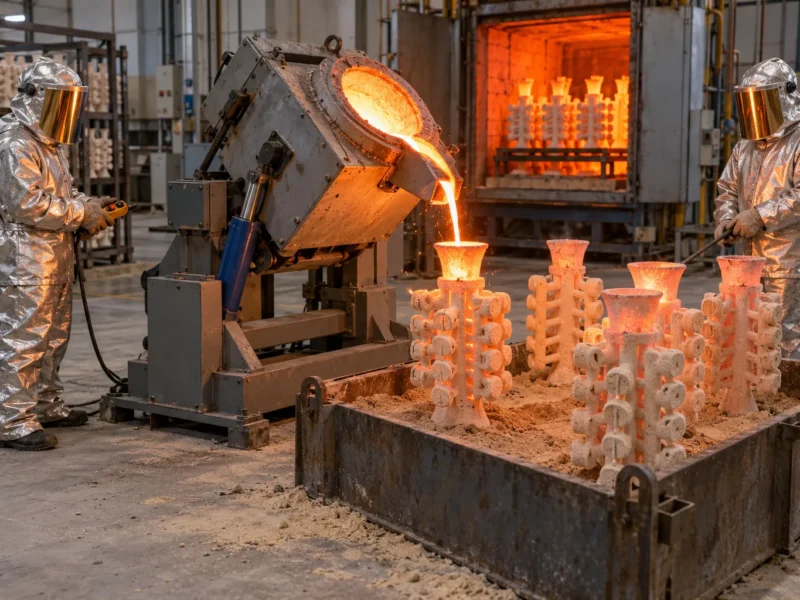
Investment casting, die casting and sand casting all make near-net-shape metal parts, but they suit different alloys, sizes and volumes. The alloy usually decides first: die casting is limited to aluminum, zinc and magnesium, so a steel or stainless part is a choice between investment casting, sand casting, forging or machining from bar.
How each process works
- Investment casting (lost-wax): wax patterns are coated with a ceramic shell, the wax is melted out and metal is poured into the hot shell. The shell is broken off, so each shell is used once.
- Die casting: molten aluminum, zinc or magnesium is injected under high pressure into a permanent steel die.
- Sand casting: metal is poured into a mold of bonded sand formed around a pattern. Each mold is used once.
Comparison
| Investment casting | Die casting | Sand casting | |
|---|---|---|---|
| Typical alloys | Stainless, carbon, alloy and tool steels; copper alloys; also aluminum | Aluminum, zinc, magnesium | Iron, steel, aluminum, copper alloys |
| Detail and thin walls | Very good | Very good | Limited |
| Typical tolerance (ISO 8062-3) | DCTG 4–6 silica sol, 7–9 water glass | About DCTG 4–7, by alloy | Often DCTG 9–13 |
| As-cast surface (typical) | Ra 3.2–6.3 µm silica sol | Ra 0.8–3.2 µm | Ra 12.5–25 µm or rougher |
| Tooling | Aluminum wax die, moderate cost | Hardened steel die, high cost | Wood, resin or metal pattern, low cost |
| Economic volume | Prototypes to medium-high volumes | High volumes | One-off to medium volumes |
| Part size | Small to medium | Small to large | Small to very large |
Typical, simplified comparison; values depend on part size, alloy and foundry practice.
Rules of thumb
- Steel or stainless with complex shape? Investment casting is usually the first choice.
- Aluminum or zinc at high volume? Die casting is usually cheaper per part.
- Very large or very low volume parts in iron or steel? Sand casting keeps tooling cost low.
- Small steel part now machined from bar, a few thousand a year? Compare the machined price with an investment casting plus finish machining.
Within investment casting there are two main shell routes; see silica sol vs water glass. For aluminum and zinc die castings, see our sister site diecasttooling.com.
Frequently asked questions
Is investment casting more expensive than sand casting?
Per part usually yes, but investment castings often need much less machining, so the total cost of a finished part can be lower, especially for small complex steel parts.
Can stainless steel be die cast?
Not in practice. Die casting is used for low-melting non-ferrous alloys; stainless steel parts are investment cast, sand cast or machined.
Which process gives the best surface?
Die casting and silica sol investment casting give the smoothest as-cast surfaces; sand casting is the roughest.
Have a casting to discuss? Send your drawing or 3D file, the alloy grade and the annual volume through our inquiry form. We review castability and reply with a quotation.