China United Mould

Logo 2021

Silica Sol Investment Casting

Silica sol process

Silica sol casting: fine surfaces and tight dimensions

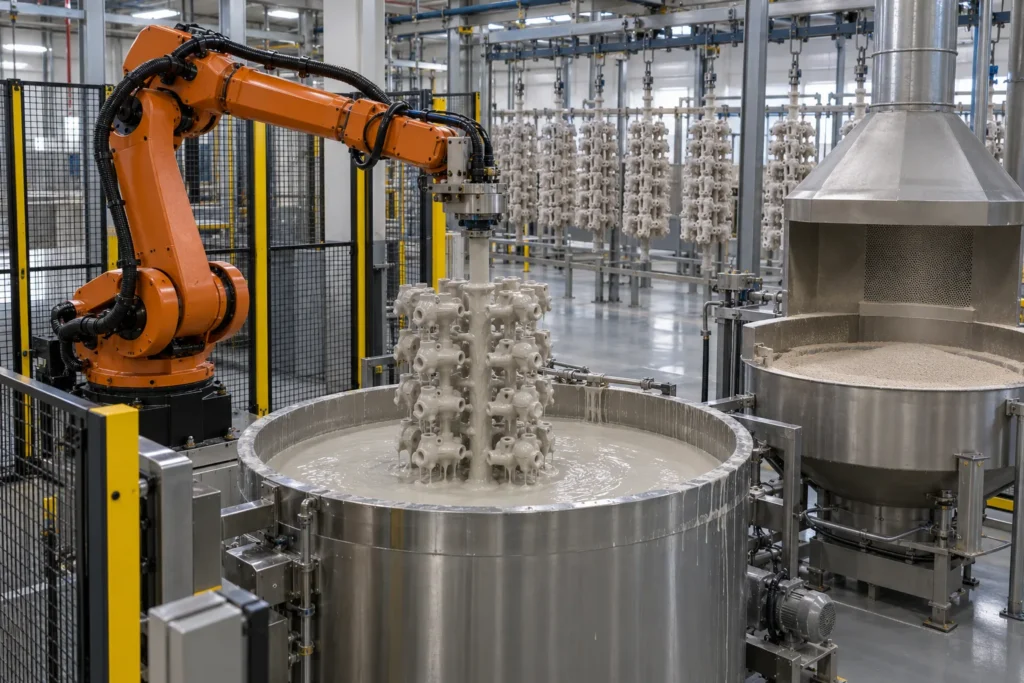
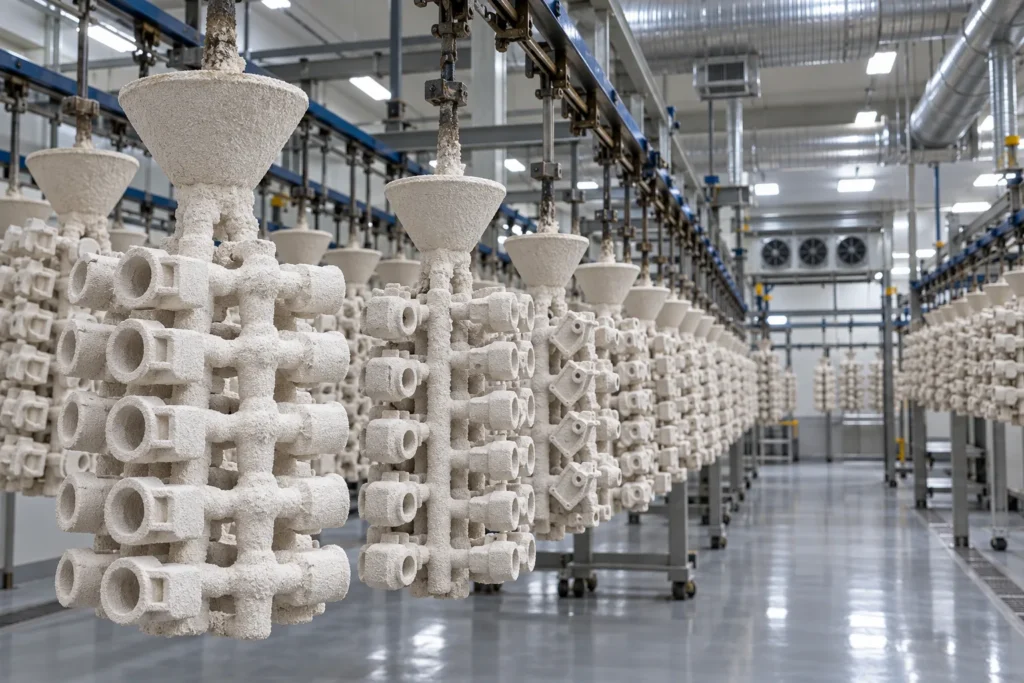
In silica sol investment casting the shell is bonded with colloidal silica. The face coats are zircon flour slurry with fine zircon sand; the back-up coats use fused silica or mullite (aluminosilicate) sand. A shell typically has 5–7 coats, and each coat dries for several hours at controlled temperature and humidity, so building one takes about two to three days. Dewaxing is done in a steam autoclave and the shell is fired at about 1,000–1,100 °C before pouring.

The fine zircon face copies the wax pattern closely, which gives the best surface and dimensional accuracy of the two shell routes. Silica sol is the usual route for 304, 316 and 17-4PH parts, thin walls and fine detail, and for surfaces left as-cast: pump and valve parts, food machinery parts, marine hardware and instrument parts.

Robot dipping a wax tree in ceramic slurry beside a sand stucco unit
Silica sol ceramic shells hanging to dry in a humidity-controlled drying room

Where silica sol casting fits best

Silica sol casting at a glance (typical)

Shell binderColloidal silica (silica sol)
Face coatZircon flour slurry, fine zircon sand stucco
Back-up coatsFused silica or mullite (aluminosilicate) slurry and sand
Coats and dryingTypically 5–7 coats, each dried for several hours at controlled humidity
Pattern wax / dewaxMedium-temperature pattern wax; steam autoclave dewaxing
Shell firingTypically about 1,000–1,100 °C
Surface finishTypically Ra 3.2–6.3 µm as-cast, about 1.6 µm on favorable faces
ToleranceTypically ISO 8062-3 DCTG 4–6
Common alloysStainless steels, alloy steels, tool steels

Silica sol casting FAQ

Why is silica sol casting more expensive than water glass?

The shell uses zircon face coats, more coats in total and hours of controlled drying per coat, so it takes two to three days to build instead of about one. In return it gives a smoother surface and tighter dimensions.

Is silica sol casting only for stainless steel?

No. It is the usual route for stainless steel, but carbon, alloy and tool steels are also cast in silica sol shells when the surface or accuracy matters.


Have a casting in mind? Send us your drawing for a quotation.