



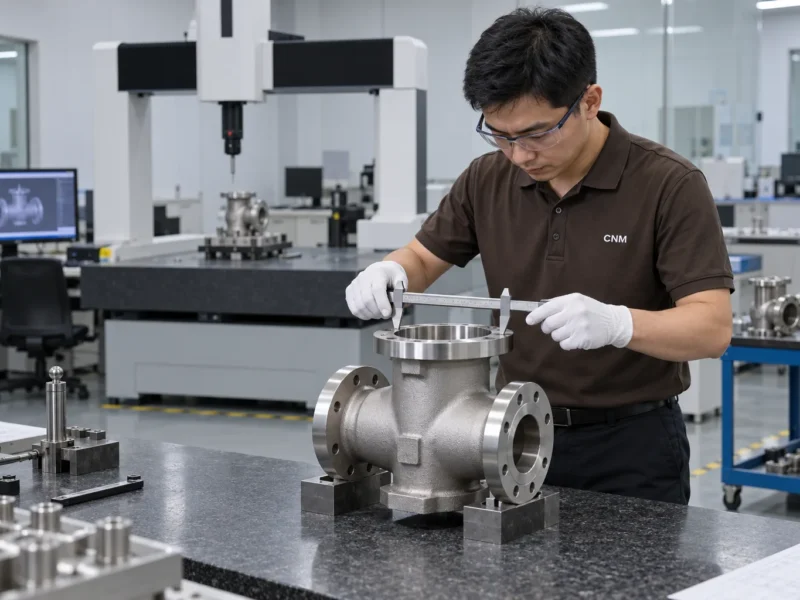
Investment castings are accurate for a casting, but they do not hold machined tolerances. A drawing that applies a general casting tolerance and tightens only the critical features is easier to quote, cheaper to make and easier to inspect.
ISO 8062 casting tolerance grades
ISO 8062-3 defines dimensional casting tolerance grades (DCTG, often written CT) from DCTG 1 (tightest) to DCTG 16. For a given grade the total tolerance grows with the nominal size: in DCTG 6, for example, a dimension between 40 and 63 mm has a total tolerance of 0.70 mm (±0.35 mm), and one between 100 and 160 mm has 0.88 mm. The same standard also defines geometrical casting tolerance grades (GCTG) and required machining allowance grades (RMAG). Typical grades:
| Process | Typical CT grade |
|---|---|
| Silica sol investment casting | DCTG 4–6 |
| Water glass investment casting | DCTG 7–9 |
| Die casting (for comparison) | About DCTG 4–7, by alloy |
| Sand casting (for comparison) | Often DCTG 9–13 |
Typical values; the foundry confirms the achievable grade for each part.
What affects accuracy
- Size: longer dimensions shrink more in absolute terms and vary more. Steel typically shrinks about 1.5–2.5% overall, and the actual value depends on how the shell restrains the part.
- Geometry: long thin sections, large flat areas and unsupported features can distort.
- Alloy: each alloy shrinks differently; the wax die is sized for it.
- Shell process: silica sol shells hold dimensions better than water glass shells.
- Straightening and heat treatment: can move dimensions after casting.
How to specify tolerances on a casting drawing
- Apply a general casting tolerance in the title block, for example “ISO 8062-3 DCTG 6” for silica sol parts.
- Mark only the truly critical dimensions with tighter tolerances, and expect those to be machined.
- Define datums that exist on the casting, so inspection is repeatable.
- Specify flatness and straightness only where they matter.
Design choices that make tolerances easier to hold are covered in our investment casting design guidelines.
Frequently asked questions
Can investment casting replace machining entirely?
For many features, yes. Bores, threads, sealing faces and tight-tolerance fits are usually still machined.
What is the difference between CT and DCTG?
They mean the same grade. DCTG (dimensional casting tolerance grade) is the term in ISO 8062-3:2007; CT comes from the older ISO 8062:1994 and is still common on drawings. GB/T 6414 uses the same grades.
Have a casting to discuss? Send your drawing or 3D file, the alloy grade and the annual volume through our inquiry form. We review castability and reply with a quotation.