Stainless steel
Stainless steel castings for corrosive and hygienic applications
Stainless steel is one of the most common materials for investment castings. In cast form the usual grades are specified to ASTM A351, A743, A744 or A747, or to EN and GB standards:
- 304 / CF8 and 316 / CF8M (austenitic) for water, food and many chemicals; 316 adds molybdenum for chlorides. CF3 and CF3M are the low-carbon versions for welded parts.
- 17-4PH / CB7Cu-1 (precipitation hardening) where strength and corrosion resistance are both needed.
- 2205 / CD3MN (duplex) for seawater and chloride service.
- 410 / CA15 and 420 / CA40 (martensitic) where the part is hardened for wear.
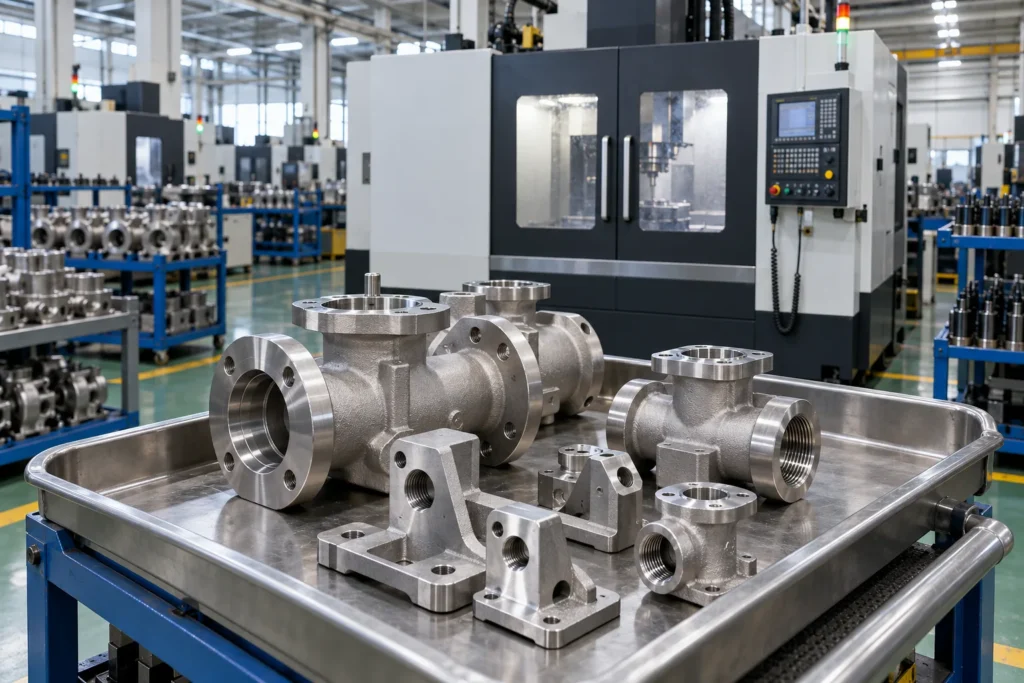
Stainless castings are normally made by the silica sol route. Austenitic grades are solution annealed, typically at 1,040 °C or above with a water quench; 17-4PH is solution treated and aged to the condition on the drawing, such as H1150. Passivation, polishing or electropolishing follow as specified.
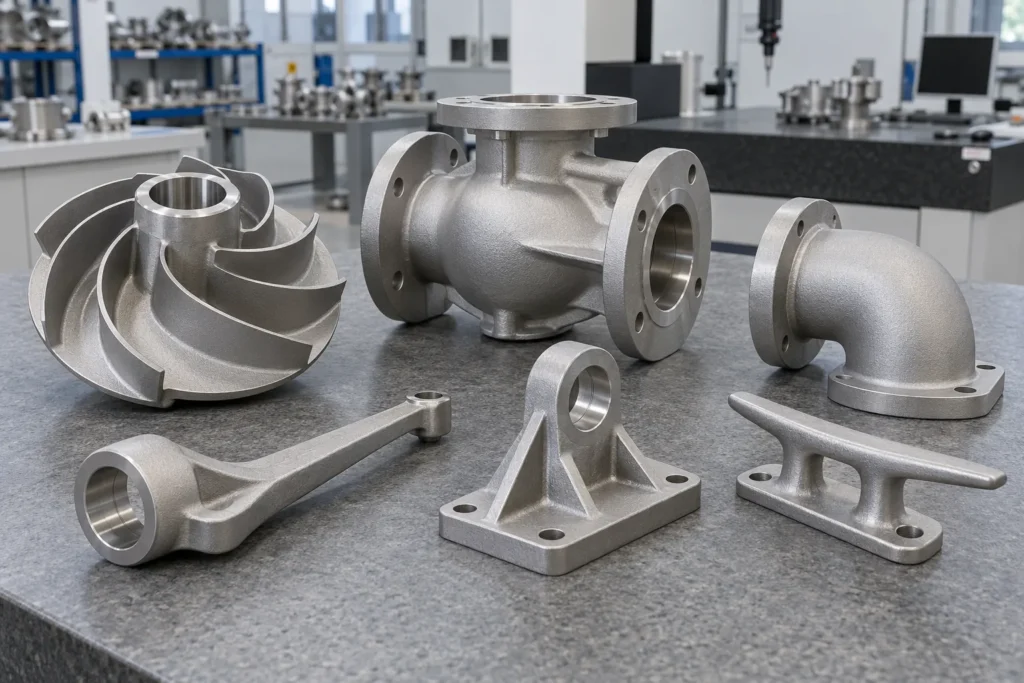
Typical stainless steel castings
- Pump impellers, casings and covers
- Valve bodies, discs and stems
- Pipe fittings, flanges and couplings
- Food and dairy machinery parts
- Marine hardware and fittings
- Medical and laboratory instrument parts
- Door, window and architectural hardware
Stainless steel casting FAQ
What is the difference between 304 and 316 castings?
316 (CF8M) contains molybdenum and resists pitting and chloride corrosion better than 304 (CF8), so it is preferred for marine, chemical and many food applications.
Are stainless castings heat treated?
Yes, in most cases. CF8 and CF8M are solution annealed, typically at 1,040 °C or above and water quenched, to dissolve carbides and restore corrosion resistance. 17-4PH (CB7Cu-1) is solution treated and then aged to the condition on the drawing, for example H1025 or H1150. Martensitic grades such as CA15 are hardened and tempered.
Can stainless castings be passivated or electropolished?
Yes. Passivation (for example to ASTM A967) removes free iron from the surface after machining and blasting. Electropolishing gives a bright, smooth, easy-to-clean surface for food and medical parts.