



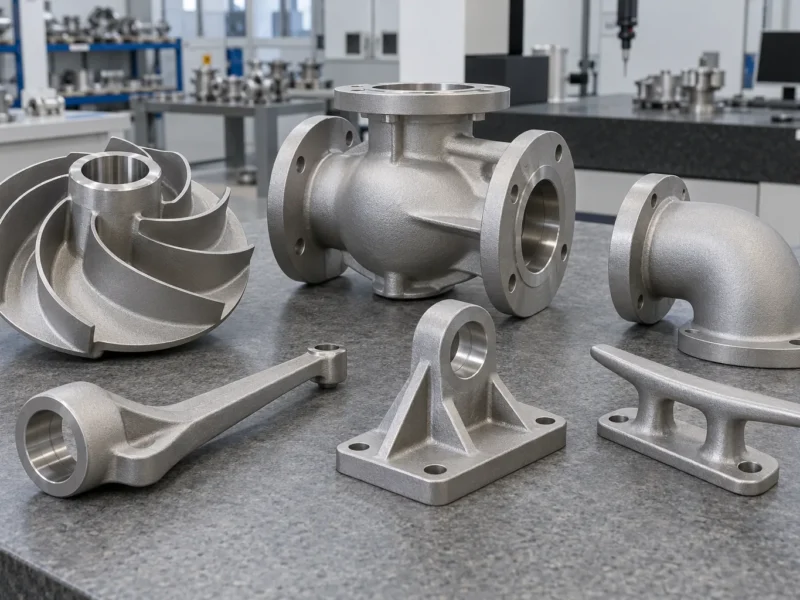
Three stainless steels cover most investment casting applications: 304, 316 and 17-4PH. In cast form they are usually specified as ASTM grades CF8, CF8M and CB7Cu-1. This guide compares them.
| 304 (CF8) | 316 (CF8M) | 17-4PH (CB7Cu-1) | |
|---|---|---|---|
| Type | Austenitic | Austenitic with molybdenum | Precipitation-hardening martensitic |
| Corrosion resistance | Good | Better, especially against chlorides | Good, similar to 304 in many environments |
| Strength | Moderate | Moderate | High after aging |
| Hardenable | No (work hardens) | No | Yes, by solution treatment and aging |
| Magnetic | Slightly, because of ferrite in the cast structure | Slightly, because of ferrite in the cast structure | Yes |
| Typical heat treatment | Solution anneal, typically 1,040 °C min., water quench | Solution anneal, typically 1,040 °C min., water quench | Solution treat about 1,040 °C, then age at about 480–620 °C (H900–H1150) |
| Cast standard | ASTM A351 / A743 / A744 CF8 | ASTM A351 / A743 / A744 CF8M | ASTM A747 CB7Cu-1 |
| Typical uses | Food equipment, general hardware | Marine, chemical, pump and valve parts | High-strength valve, pump and industrial parts |
Typical comparison; the standard on your drawing governs chemistry and properties. Cast grades contain some ferrite and differ slightly from wrought grades.
How to choose
- Start with 304/CF8 for general corrosion resistance at the lowest cost.
- Choose 316/CF8M for seawater, chlorides, many chemicals and demanding food applications.
- Choose 17-4PH when the part needs high strength or hardness with good corrosion resistance.
- Use the low-carbon versions (CF3, CF3M) where the part will be welded.
More alloys are listed on our alloys page; cost effects are covered in investment casting cost.
Frequently asked questions
Is cast 316 the same as wrought 316?
Not exactly. CF8M is the cast counterpart of 316. Its chemistry is balanced to leave some ferrite in the austenite, which reduces hot cracking and makes the casting slightly magnetic.
Which is cheaper, 304 or 316 castings?
304 is usually cheaper because 316 contains molybdenum and more nickel.
Have a casting to discuss? Send your drawing or 3D file, the alloy grade and the annual volume through our inquiry form. We review castability and reply with a quotation.