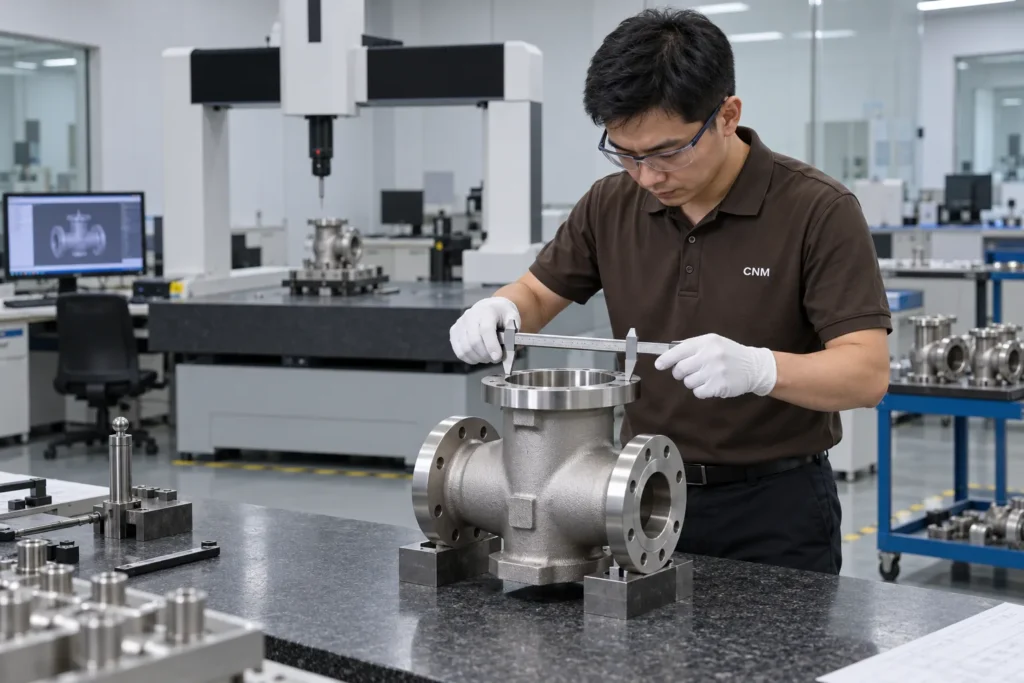
| Dimensional | First article inspection report against every drawing dimension; production checks with calipers, height gauges, go/no-go gauges, fixtures or CMM. |
|---|
| Chemical composition | Optical emission spectrometer (OES) analysis, typically one sample per heat, against the specified grade. |
|---|
| Mechanical properties | Tensile and hardness tests on separately cast or attached test bars, or hardness on the parts, after heat treatment. |
|---|
| Visual (VT) | Surface condition against the agreed standard, for example MSS SP-55 for valve and fitting castings. |
|---|
| Penetrant (PT) and magnetic particle (MT) | Surface-breaking defects. MT only works on magnetic grades such as carbon steel, 17-4PH and martensitic stainless; austenitic 304 and 316 castings are checked by PT. |
|---|
| Radiography (RT) | Internal shrinkage, porosity and inclusions, graded against ASTM E446 or E192 reference radiographs where the specification calls for it. |
|---|
| Pressure tightness | Hydrostatic or air leak testing of pressure-containing parts, where required. |
|---|
| Documents | Inspection reports and material certificates as agreed, for example an EN 10204 3.1 certificate with chemistry per heat. |
|---|